

DC Insights

Strong trade growth, rising manufacturing-focused FDI, and manageable inflation underscore Vietnam’s resilient economic outlook.
Vietnam’s expansion stayed on track in May, still led by manufacturing and investment. What shifted is the emphasis: the caveats now matter as much as the momentum. Inflation is closing on the policy ceiling, the trade balance has swung into deficit, and equity-market leadership has narrowed, though none of it points to a turn in the underlying cycle.
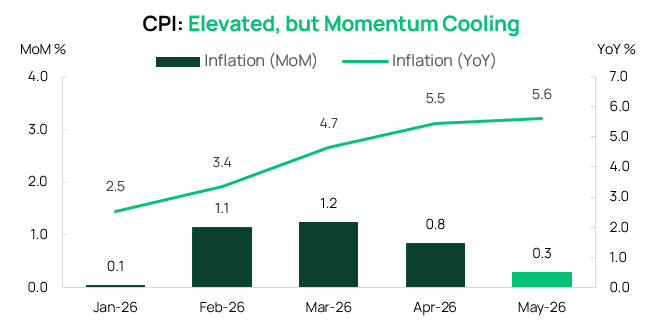
Inflation is the most pressing of the three. May CPI rose 5.6% YoY, lifting the 5M26 average to 4.3%, with core at 4.0%. The pressure now comes from more persistent sources: housing, electricity, water, construction materials and transport, while food prices eased month on month. With the average still inside the government’s 4.5–5.0% band, policy room has not closed, but it has narrowed to the point where a further rise in energy or logistics costs would test it.
The trade numbers point the same way. Total trade reached $445.1bn in 5M26, up 25.0% YoY, but imports grew 30.8% against exports of 19.5%, turning the balance to a $13.8bn deficit after years of surplus. The composition argues against reading this too negatively: production goods made up 94.1% of imports, the profile of an economy building capacity, not one living beyond its means. The deficit says more about the timing of the investment cycle than about competitiveness, though it could add to FX pressure if it persists and the import build does not convert into export growth.
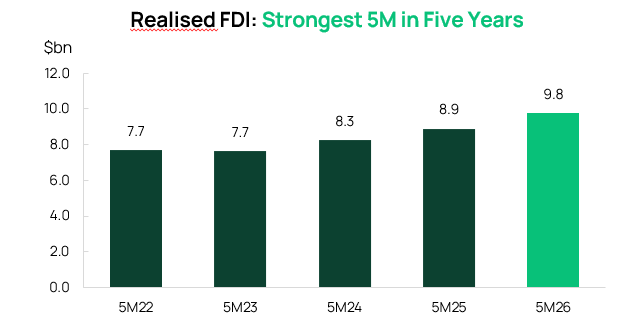
Behind those imports sits an investment cycle that has not slowed. Realised FDI reached $9.8bn in 5M26, up 9.6% YoY and the strongest five-month total in five years, with registered FDI up 34.9% to $24.8bn and manufacturing taking over 80%. Public investment disbursement of roughly $9.7bn, 24.0% of the annual plan, ran alongside it. IIP rose 8.8% YoY in May and 9.1% over 5M26, the strongest in four years, with breadth still extending beyond electronics into metals (+20.2%), motor vehicles (+18.0%) and chemicals (+16.9%). PMI rebounded to 52.8 from 50.5, though part of that was inventory building.
Domestic demand is steady. Retail sales and services revenue rose 11.2% nominally over 5M26 but 6.1% in real terms. Services remain the stronger leg, with accommodation and food up 13.3% and tourism revenue up 12.2% on 10.6 million international arrivals (+14.9%).
Equity markets remained cautious. The VN-Index returned 1.0% MoM in total return USD terms, lifting YTD returns to 4.9%, touching a record 1,927 mid-month before closing at 1,863. Combined liquidity stayed at around $1.0bn, and foreign investors net sold roughly $744mn. Leadership held in a narrow band of large-cap and energy names, with little participation behind the headline level. The market is making the same point as the macro data: the cycle is intact, but the upside from here depends on earnings delivery, broader liquidity, and a turn in foreign flows. The variables to watch are whether energy costs stabilise and exports rebuild through the second half, with FTSE implementation due in September the clearest near-term catalyst.
Read more about our previous monthly report Vietnam Market Insights – April 2026 here.

